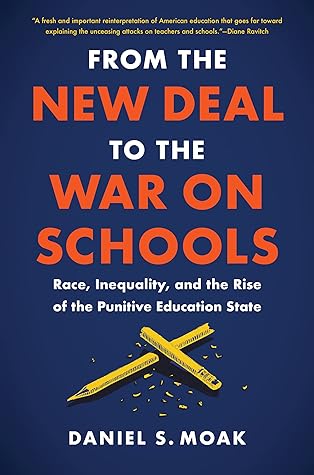
Race, Inequality and the Rise of the Punitive Education State
In the K12 education world, many believe that 2001’s “No Child Left Behind” (under George W. Bush) was the beginning of the “war on schools,” otherwise known as “reform.” Others go back to Ronald Reagan’s time. But in From the New Deal to the War on Schools, Daniel S. Moak takes us back further, to the beginning of the 20th century. There, ideas were expressed by “scientific efficiency progressives,” which would be codified during the 60’s, and endorsed by Democrats, including LBJ and RFK. Their core claim was that public education is the best tool to address poverty, unemployment, and racial disparity in wealth. This belief has persisted, with few challenges, to this day.
I taught math for 18 years at Berkeley High School (BHS), retiring seven months ago. Because Berkeley is still thought of as one of America’s most liberal cities, it may come as a surprise to learn that the Black/White achievement gap at BHS is one of the worst in the nation. In fact, it was ranked as the worst in recent studies, with a five-year learning gap between White and Black students. While there is reason to be skeptical about the exact numbers – the gap is measured by state test scores, and BHS students do not care a lot about state tests! – still, the number of Black students most years in “advanced math” is typically 0 or 1 of 150; the proportion of Black students in Calculus is similar; and of the kids who fail Math 1, most are Black – in a school in which only 12% of 3200 are Black. Still, in Berkeley, the belief that we can “teach our way to equality” goes virtually unchallenged.
Moak does a great job of introducing the key characters and ideas in the last hundred years of the history of education. He introduces the “social reconstructionists” who fought against the prevailing philosophy of the scientific efficiency progressives. Of these, the main character is George Counts, who criticized education for promoting “rugged individualism,” and for reproducing the existing social order. (Public schools still see their role is to prepare each individual for success in college, in preparation for inclusion into the business world as it is currently constituted. At best, some educators hope for diversity among the “best” students – such “progressives” Moak characterizes as “incorporationist” – but this doesn’t happen, while class rigidity only worsens.) Counts, however, believed that it is the job of schools to present students with a socialist vision for the country, as necessary to achieve the egalitarian society we (supposedly) desire. Moak references his classic speeches on the subject, which are bundled into a pamphlet: Dare the School Build a New Social Order? Counts and his allies had their day in the early years of the Great Depression, when for a moment people saw through the lie that capitalism and the capitalists are what’s best for America – but by the late-30’s, they were in retreat, and during the McCarthy era, Counts was forced to renounce all of his progressive beliefs.
Moak takes us next to a similar debate among Black educators, between the aforementioned incorporationists (fine with capitalism, just seeking racial equity), and those seeking economic reform. Moak explains that in part due to the Supreme Court’s willingness to recognize Fourteenth Amendment anti-segregation arguments, incorporationist strategies were deemed more practical, while also being less threatening to White upper classes. (These same forces shaped the future of the NAACP.) We learn that the Brown v. Board of Education case was won by stressing the supposed psychological effects of poverty, rather than its direct economic consequences. By the 60’s, there were few still in support of economic reform – with the notable exception of Bayard Rustin, and, though not mentioned in the book, MLK Jr. in his final years. There was general consensus, then, in the dubious notion that poverty would be eradicated by eliminating Black/White educational disparity – without addressing the issue of many low-paying jobs, and the exploitation of workers. Moak does not make clear why people believed this — or whether in fact they merely claimed to. This belief in turn depended on a second foundational belief: that unequal educational outcomes could be ended merely by integrating schools, with modest compensatory funding going to poor districts. But how is that possibly going to be sufficient, given that poverty contributes so many obstacles to a relatively poor child attempting to access educational experiences: families live in considerable stress; children don’t have food security, a quiet place to study, or family members capable of tutoring; children and caregivers lack decent physical and mental healthcare, etc. Again, Moak doesn’t weigh in on the sincerity of the supposed believers. In any case, most people, including most teachers, believe – or claim to – to this day.
In 1966, however, the Coleman Report cast doubt on these naive beliefs – or ought to have. James Coleman concluded, as Moak quotes, that “it appears that differences between schools account for only a small fraction of the differences in pupil achievement.” The report found that “80% of variation in student achievement occurred within schools.” However, rather than reject the hypothesis that the disparity in learning can be readily eradicated through integration and school funding alone – that is, ignoring the impact of enormous economic inequality between Black and White families (in Berkeley, in the current day: 28 cents earned by Black households for every dollar earned by White!) – the conclusion was that teachers just weren’t trying hard enough. (At BHS, the explanation is that it’s the implicit bias of teachers, leading to microaggressions, that is responsible.) So while Reagan and Bush were undoubtedly happy not to have to address economic inequality, Democrats in the 60’s, notably Robert F. Kennedy and LBJ, were either blind to the reality of poverty, or were equally unwilling to question the premises of capitalism.
Jump forward a few years to the Obama administration, and the only significant changes are that now charter schools are big business opportunities, and economic inequality has only gotten worse. NCLB and “Race to the Top” have mandated state testing – which charter entrepreneurs employ to “prove” that public schools are failing. And it continues on through Trump – Moak notes that Trump’s rhetoric is nearly identical – now on to Biden. Sigh.
Moak ends with some hopeful recounting of the “Red State Revolt,” and the strikes in Chicago, in which teachers briefly demonstrated their power when acting collectively. However, neither the two major national teachers unions nor any other force within education has yet taken up the economic reform cause, and therefore, there is as yet no reason to expect any progress in reducing either educational or economic inequality in this country.
Of the writing itself, I must say that it needs to be recognized and accepted as the product of a doctoral dissertation. As such, the reader can expect redundancy due to adherence to a form for each chapter of: intro / discussion / conclusion, leading to ideas being presented almost identically up to three times. However, the upside is that there is a wealth of interesting footnotes, and a huge bibliography.
The other major weaknesses are of omission. In recent decades, application of statistical techniques to huge data sets by Sean Reardon and others, has established that the primary factor in predicting a child’s educational success is their parents’ wealth: thus making clear the correct interpretation of the Coleman Report and all subsequent studies which have shown that contrary to expressed hopes of reformers, integration and a bit of extra money for schools is not going to be at all sufficient in leveling the playing field. Unfortunately, Moak does not present this development in research; without it, the reader might reasonably conclude that maybe it is all about lazy / incompetent/ racist teachers.
There are other points which remain unclear. For instance, did Counts and the economic reformers only consider changes to curriculum, or did they advocate collective action?
Most other omissions could be considered beyond the scope of the book, so here I don’t fault Moak. However, I do hope that he or others will write a follow-up! If so, they will need to question which of the claims and rationalizations unearthed by Moak are made in good faith, and which are self-serving BS. They will need to explain why teachers and those who genuinely do want a more egalitarian society continue to buy disproven arguments – ignoring Reardon’s results. That is, why has a new generation of economic reformers among educators failed to materialize? And what are the purposes of education? Much as I love Counts, there are many more purposes than encouraging young socialists.
Ultimately, what is going on in this country is not just a war on schools. It is a war on poor kids, and for that matter, middle class kids. It is a war on adults, a war on everybody. Class rigidity is enforced in order to maintain the continuity of the process whereby the world and its creatures are being sucked dry. As Moak shows, both parties are responsible for bending education to the purpose of keeping the capitalist project moving forward, unchecked. There are 3.5 million teachers in America, and if we acted collectively – on behalf of our kids, as we have a moral obligation to do – we might be able to change course.
Dan Plonsey BFT retired

 Solidarity News